

Listen to this blog post:
Here's how AI search works, in short: AI tools like ChatGPT, Gemini and Perplexity don't search the internet on their own. The AI model writes answers from patterns it learned during training. When it needs current information, it sends several rewritten searches to a search engine, keeps the top results, and reads small pieces of those pages before writing its answer.
That's why SEO still decides whether your business shows up in AI answers. If a search engine doesn't return your page, the AI never sees it.
More buyers now ask AI tools for recommendations, and many businesses are being sold "answer engine optimization," or AEO, as the fix. Before you spend money on it, it helps to understand what actually happens between a buyer's question and the AI's answer. Here's the process, step by step.
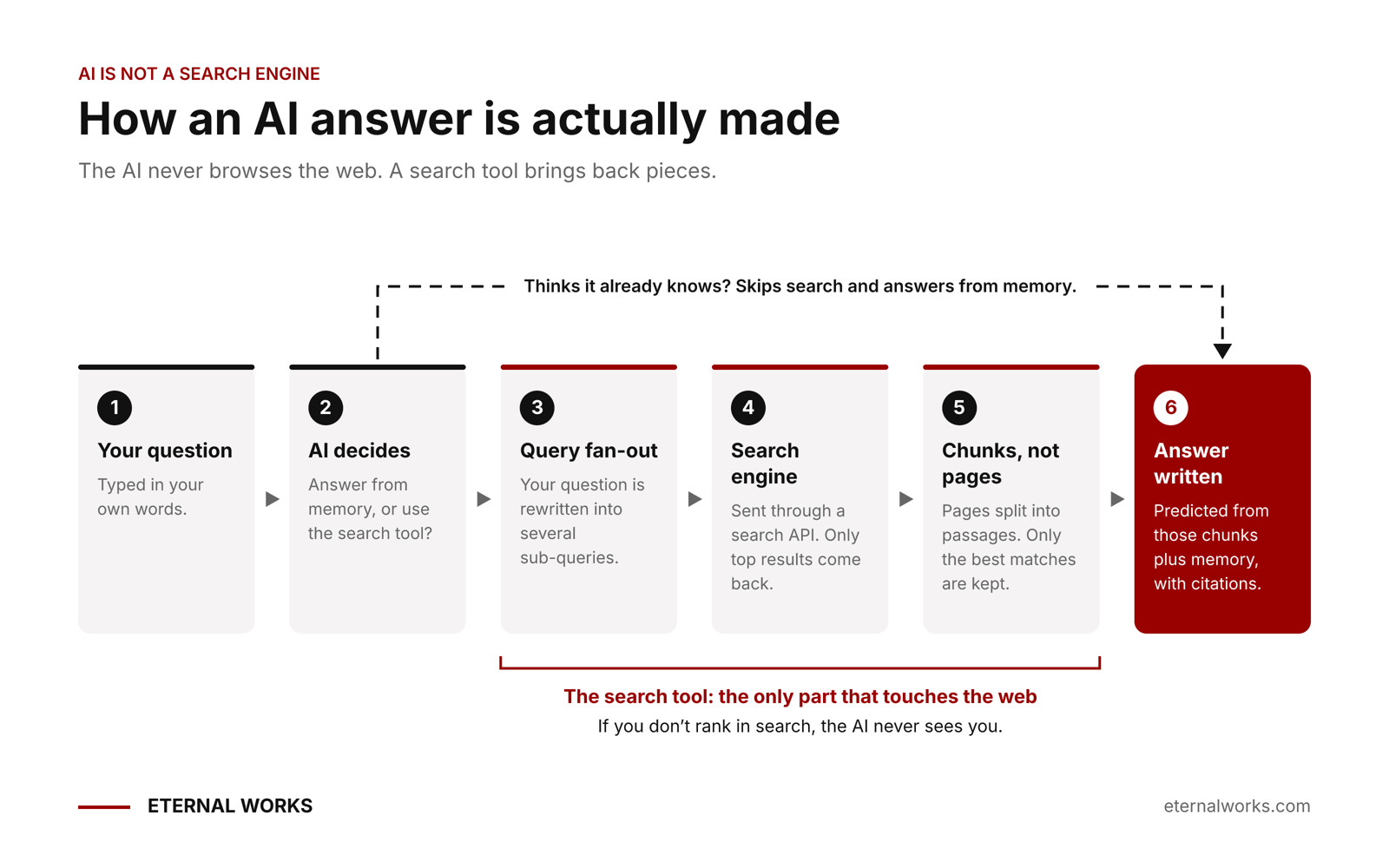
Only steps 3–5 touch the web, and only through a search engine.
What does an AI model actually know?
An AI model knows what it learned from its training data, up to a fixed cutoff date. It doesn't store web pages, and it can't look anything up by itself.
The tools most people use, including ChatGPT, Gemini, Claude and Perplexity, run on large language models (LLMs). An LLM predicts text. Given a question, it works out the most likely next word, then the next, until it has written a full answer. It learned to do that by training on a huge snapshot of books, websites, articles and code.
Two things about that snapshot matter for businesses:
- It's frozen in time. Every model has a training cutoff. Anything that happened after that date, including changes to your services, pricing or team, isn't in its memory.
- It stores patterns, not pages. The model can't open a page it saw during training or reliably say where a fact came from. When it fills a gap with something that sounds right but isn't, that's called a hallucination.
Can ChatGPT search the internet on its own?
No. The AI model is a large file of numbers running on a server. It can't open a browser, click a link or visit your website.
What these tools can do is use a search tool. The companies that build them wrap the model in software that lets it request a web search when it decides it needs fresh information. The software sends the search to a search engine, collects the results, and passes the text back to the model, which then writes its answer. The technical term is retrieval-augmented generation (RAG): retrieve information first, then generate the answer.
A quick way to tell which happened: if an AI answer shows no sources, it was most likely written from memory, not from the web.
Which search engines do AI tools use?
AI tools rely on existing search engines and indexes rather than searching the web from scratch:
- Google AI Overviews and AI Mode run on Google Search.
- ChatGPT search draws on Bing-style third-party results combined with OpenAI's own web crawl.
- OpenAI and Anthropic have both said they use third-party search engines, such as Bing and Brave, alongside their own crawlers.
These arrangements change, and providers don't publish every detail. But the pattern holds across all of them: AI runs on top of search, not instead of it.
What is query fan-out?
Query fan-out is when an AI tool turns one question into several narrower searches and runs them at the same time. The term comes from Google, and other AI tools work in a similar way.
Google's own example: ask about things to do in Nashville with a group, and the system may search separately for good restaurants, good bars, things to do with kids and more, then combine the results into one answer.
A few things to know about fan-out:
- Simple questions skip it. A fact like the capital of Spain needs no extra searches.
- Complex questions can trigger many. Google says its Deep Search feature can run hundreds of searches for a single question.
- It isn't just Google. OpenAI says ChatGPT search rewrites a prompt into one or more targeted queries.
- The searches are invisible. Neither the person asking nor the businesses being searched can see which searches the AI ran.
For a business, this means the AI may be searching for things your buyer never typed, phrased more like specific questions than short keywords.
Does SEO still matter for AI search?
Yes. SEO is what decides whether AI tools ever see your business.
When an AI tool searches, it sends its queries through a search engine's API and gets back that engine's ranked results. It only looks at the top of that list. If your page doesn't rank for those searches, the AI never reads it, so it can't quote you, cite you or recommend you.
Put simply: if you don't have good SEO, you won't show up in AI answers. AI visibility is built on top of search visibility.
We saw this firsthand with a specialized consulting firm. In almost every meeting, the client told us that if we could get them to show up in ChatGPT for their specialty, they'd hand over their bank account number. Their real worry wasn't that they never appeared. It was that they didn't think they appeared often enough, and that competitors might be showing up more.
So we checked. When we ran their target questions ourselves and compared the results with their data in Google Search Console, they were being cited far more often than their competitors. When they asked how, we walked them through how AI tools rely on traditional search. Their strong search presence was the reason they showed up in AI answers.
Instead of chasing a new AI tactic, we built a plan to protect and extend the search advantage they already had. That saved them thousands of dollars and months of work on something they didn't need.
For AI search, "good SEO" means the fundamentals done well:
- Search engines can crawl and index your site, in Bing as well as Google.
- You rank for longer, question-style searches, the kind fan-out produces, not only a few headline keywords.
- Your site has the authority signals search engines trust, such as quality links and a consistent presence across the web.
One practical step many businesses miss: submit your sitemap to Bing Webmaster Tools, not just Google Search Console. ChatGPT leans on Bing-style results, and plenty of sites have never been set up in Bing. If you want help with the fundamentals, see how we approach search engine optimization.
How much of my page does AI actually read?
Usually just a few passages. AI tools don't read your page from top to bottom the way a person does.
After a search, the system takes only the top handful of results. It splits those pages into chunks, short passages usually broken up along headings, paragraphs and lists. Each chunk is compared with the search it came from, and only the closest matches are passed to the AI model. Some tools read pages through a sliding window, pulling a fixed slice of text at a time.
This happens because an AI model can only hold so much text at once, and every word it processes costs time and money. Reading every page in full for dozens of searches isn't practical.
The result: an AI answer can miss the caveat in paragraph nine, the footnote, or the pricing table that wasn't selected. It writes from fragments. That's also why a citation in an AI answer means a passage from that page was used, not that the AI read and checked the whole page.
How is AI search different from a search engine?
A search engine shows you a ranked list of pages and lets you choose. An AI tool chooses for you, using a few passages from a few pages, and writes a single answer.
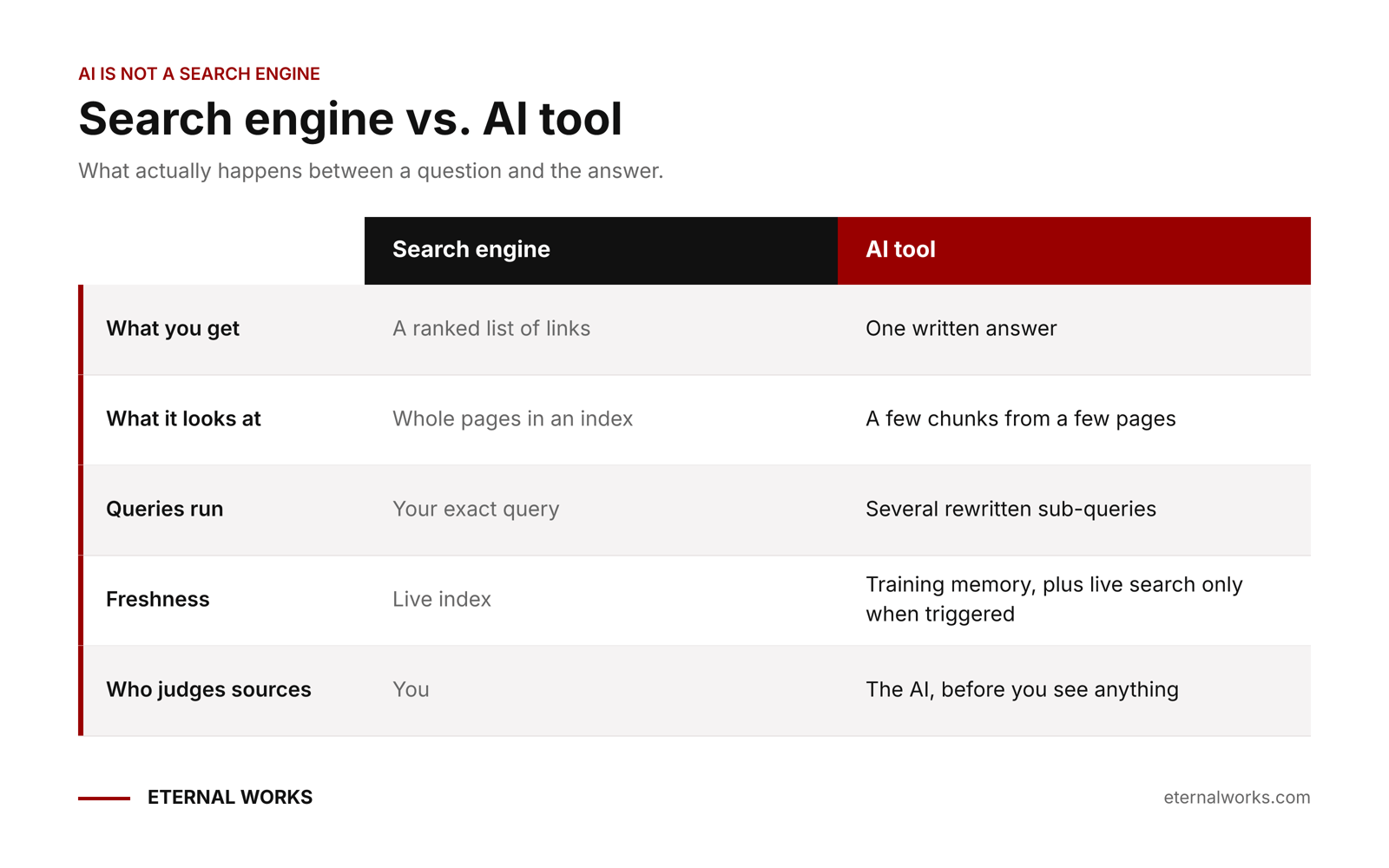
A search engine shows you the options. An AI tool chooses for you.
| Search engine | AI tool | |
|---|---|---|
| What you get | A ranked list of links | One written answer |
| What it looks at | Whole pages in an index | A few chunks from a few pages |
| Searches run | Your exact query | Several rewritten searches |
| Freshness | Live index | Training memory, plus live search only when it decides to |
| Who judges sources | You | The AI, before you see anything |
Do you need AEO?
You don't need a separate AI strategy as much as you need the fundamentals done well. There's no separate AI index to rank in. Google itself says there are no additional requirements to appear in AI Overviews or AI Mode: a page needs to be indexed and eligible to show a snippet in regular Search. AI tools read from search engines and from what the rest of the web says about you.
Once you understand how AI search works, it's easier to separate what you can influence from what you can't.
What you can't control:
- What the AI model learned in training, and when its knowledge stops
- Whether it decides to search at all
- Which searches it creates from a buyer's question
- Which passages it keeps and how it words the answer
What you can control:
- Whether search engines can find, index and rank your site for the questions your buyers ask
- Whether your pages answer those questions plainly enough that any single passage makes sense on its own
- What the rest of the web says about you, including reviews, directory listings, articles and mentions
Everything in the second list existed before AI. That's the point. The work that gets you into AI answers is still SEO, clear content and a strong reputation. If you're not sure who your best buyers are or what they ask, start there.
At Eternal Works, we build this around a framework we call the Core 9: the nine questions every buyer needs answered before they choose a company, from what problem you solve and what it costs to what results they can expect. Clear answers to those questions, published on your site and repeated everywhere your buyers spend their attention, are exactly what you control. They're also exactly what an AI tool has to work with.
One caution: some businesses try to publish a separate page for every question they think AI might search. Google's spam policies treat mass-producing pages mainly to manipulate search rankings as scaled content abuse, and a page for every guessed search can cross that line. Fewer, better answers to the questions buyers really ask will serve you better.
How to check whether AI tools can find your business
You can get a good read on your AI visibility in under an hour. Work through these checks:
- Search your main service in Google and Bing. Note whether you appear on the first page of both.
- Confirm your site is set up in Bing Webmaster Tools as well as Google Search Console, with a current sitemap submitted to each.
- List the Core 9 questions your buyers ask before they buy, such as what it costs, how long it takes and what results to expect.
- Check that your website answers each one clearly, under a heading that matches the question.
- Read each answer on its own. If someone saw only that paragraph, would it still make sense?
- Compare how you're described elsewhere. Your reviews, directory listings and other sites should describe what you do the same way your website does.
- Ask the AI tools directly. Ask ChatGPT, Gemini or Perplexity about your category, then note whether you're mentioned and which sources they cite.
If you're missing more than two of these, that's likely why AI tools aren't recommending you yet.
Frequently asked questions about AI search
Does ChatGPT use Google or Bing?
ChatGPT search relies mainly on Bing-style third-party results combined with OpenAI's own web crawl. OpenAI doesn't publish the exact mix, and it can change. Setting up your site in Bing Webmaster Tools is a simple way to make sure you're covered.
Is AEO different from SEO?
AEO (answer engine optimization) describes the goal of appearing in AI-generated answers. In practice, it depends on the same foundation as SEO: being indexed and ranked by search engines, answering buyers' questions clearly, and having a consistent reputation across the web. AI tools retrieve information through search engines, so AEO without SEO has nothing to stand on.
Can an agency guarantee my business will show up in AI answers?
No one can guarantee it. No business or agency controls whether an AI tool decides to search, which searches it runs, or which passages it keeps. Be cautious of any promise that skips over search visibility, clear content and reputation.
Why does AI give wrong or outdated information about my business?
Usually for one of three reasons: the AI answered from training data that's out of date, it found outdated or conflicting information about you online, or it pulled a passage out of context. Keeping your website current and making sure other sites describe your business consistently reduces the chances of all three.
How long does it take to show up in AI answers?
There's no fixed timeline, because it depends on how quickly you rank in search for the questions your buyers ask. Improvements to search visibility, content and reputation tend to build over months, not days.
Want to know where you really stand?
If you're being told you need AEO, the first step isn't a new tactic. It's knowing whether search engines, and the AI tools built on them, can find you at all.
Eternal Works helps growing businesses find what's really slowing them down, fix what isn't working, and build the sales and marketing systems that make growth predictable and measurable. To see how we approach AI implementation and SEO, book a 30-minute discovery call with Tim: https://www.eternalworks.com/meetings/timjones/disocvery-30min-linkedin